





Location
Our base camp is East Winds Activity Centre, St Anne’s Terrace, BS4 4DY.
This is where you will drop off and collect from.
We regularly use 3 other nearby sites: Nightingale Valley Woods, St Anne’s Woods and the Local Park. These are all within walking distance.
Parking
Please note, because of the state of the lane and in respect of our neighbours, we ask that parents and carers do not bring cars down St Anne’s Terrace and there is no parking on site. We encourage parents to park on St Anne’s Park Road (on the other side of the railway bridge) and walk down the lane.
For those arriving with bike seats or trailers, bringing a buggy or wanting to leave a car seat we do have somewhere to store these items. Please speak with the manager.
Timings
Our kindergarten day runs from 8:00-15:30. Children can arrive anytime between 8:00 – 9:00 (with the exception of the settling in period). This allows for a flexible drop off when children can settle in, connect with their key person and play with friends. Please make sure you are with us by 9:00 at the latest.
Pick up time is any time between 15:00 and 15:20. If you would like to talk to your child’s key worker please allow yourself time between 15:00 and 15:20 and keep in mind that children (not booked on after kindie) and their parents should be off the premises by 15:30.
Arrivals/Drop Off
On arrival, a member of the team will welcome you at the main gate and sign your child in for the day on our famly app. We encourage all parents to drop their child off at the gate.
For their own safety, we encourage all parents/guardians to walk with their children to the main entrance. Do not let them run ahead and please wait with them whilst they are signed in.
Please see our 'Settling in Sessions' underneath and our settling in policy.
Once on site, children are further greeted by their key person or a familiar adult and will self-register. They will place their belongings in their allocated ‘box’ (to share with one other child). In addition to a box for their belongings, pegs are available to hang up coats/extra clothes on in the colder, wetter months.
Departure/pick up
Parents are encouraged to collect their child from the garden at the end of the day. This will allow parents the opportunity to come on site and speak with their child's key person or a familiar adult.
You can collect your child from 15:00 onwards but we kindly ask that it’s no later than 15:20. This allows time to gather children’s belongings and speak with the key person. If you need to collect your child earlier than this, please try and let us know in advance.
When you collect your child, we will sign them out on the Famly App. We will only allow children to leave with someone who is named on Famly as a contact. If you would like someone else to collect your child you will need to add them as a contact on your child's profile page and give them a password which you can write on the 'extra info' part of the contact page.
After Kindie Club
We provide longer hours on Monday, Tuesday, Wednesday and Thursdays in the form of an after kindie club. We provide a light tea at a cost of £2.00 (this fee is removed if self funding the session).
The session runs from 15:30 –17:30 at a cost of £18.00 per session and must be pre-booked. You can use the government-funded hours to cover the cost. If you wish to book on to the after kindie club, please email admin@outtherekindergartens.co.uk.
Please note spaces are limited to around 18 a day.
You can collect your child at any time during ‘after kindie’ but we kindly ask that it’s no later than 17.20. This allows time to gather children’s belongings and speak with the key person.
You can read more details about after kindie further on in the handbook.
Settling In Sessions
We require that the children do the following settling in sessions:
Week 1: 9:00 – 12:00 noon (no packed lunch required)
Week 2: 9:00 – 14:00 (packed lunch required)
Week 3 as normal: 8:00 – 15:20 with after Kindie available from week 3 15:30 - 17:30
During the initial settling in period, parents are welcome to come on site to help settle their child for the first 15 minutes of the day between 9.00 and 9.15.
After this initial settling in period, we encourage all parents and carers to say goodbye at the gate. This forms part of our settling in our policy. In our experience and that of our parents, this approach works really well for the majority of children. We have noticed that children are quicker to settle as a result. This may be to do with the fact that it puts the child in control as they are the one leaving the parent as opposed to the parent leaving them. Upon saying goodbye, the person at the gate will take your child to their key person who will be making those all important bonds.
It may be that your child is upset at drop off but their key person will have ideas for how to alleviate any sadness. We suggest bringing in a settling-in pack to the all about me meeting which can then be used in the first few weeks. This pack can contain a familiar toy, a favourite book and a few family photos. The good news is that usually, within 10 minutes or so of parents have said goodbye, we are texting parents and sharing photos of their child smiling and having fun. However, if a child is particularly distressed and inconsolable we will always phone the main carer/main contact so that they can either come and be with the child or collect them to take home. This happens very rarely.
We also recognise that all families are unique and some children might find it more difficult to separate from their main carer. We are therefore flexible in approach and will work with individual families to come to the right arrangement for them.
It is worth sharing how you feel about drop off with your child's key person at the all about me meeting. Please speak to the manager in person or over the phone if you'd like to discuss your child’s ‘settling in’ time with us in more detail. We may also suggest a home visit depending the needs of the child, and off the back of the all about me form and meeting.
Please see our settling-in policy for more details.
Important: If paying for your child’s place you will be invoiced for a normal session price and no discount is offered. We will invoice you for After Kindie from the third weeks unless you are fully funded.
Term Dates
We are open for 38 weeks of the year. For this reason, we start back the week after most schools. For the remainder of the year, we follow the Bristol term dates up until the summer break when we break up earlier than most schools.
Term Dates 2026/2027
Term 1: Monday 7th September 2026 to Thursday 22nd October 2026 (7 weeks)
Term 2: Monday 2nd November 2026 to Thursday 17th December 2026 ( 7 weeks)
Term 3: Monday 4th January 2027 to Thursday 11th February 2027 ( 6 weeks)
Term 4: Monday 22nd February 2027 to Thursday 25th March 2027 (5 weeks)
Term 5: Monday 12th April 2027 to Thursday 27th May 2027 (7 weeks)
Term 6: Monday 7th June 2027 to Thursday 15th July 2027 (6 weeks)
We are open for 38 weeks a year (this differs from schools, which are open for 40 weeks a year)
Please note that we are closed on bank holidays, and you will not be charged for your child’s place.

Contacting us in regards to sickness or in an emergency
If you need to inform us of your child’s absence, either sickness or holiday, please mark this on famly on your child’s profile.
https://help.famly.co/en/articles/4912433-parents-report-your-child-s-absence#h_1dd6b6f3c2
If you need to contact us in an emergency, please call the numbers below in order.
Ella Ives (manager): 07847 709448 - please note Ella works from home on Mondays and you will need to phone Miri’s number
Miri McGuiness (deputy manager): 07521 465710
Ulrike Haller (third person in charge): 07512 569320
Please note that the reception isn’t great at the scout hut or in the woods. If we don’t pick up please keep trying.
Staff Training
All staff are trained in Child Projection or Advanced Child Protection. All qualified staff and paediatric first aid qualified (12 hours or Outdoor). For further staff details, qualifications and training, please visit our staff page:
If a key person is on training or off sick, the manager will often be with the key group or a suitable person in to cover and take on their key person role. On occasions, we will also have students and volunteers working alongside us. All of students and volunteers have relevant experience and are DBS checked.
Contact details
The settings full address is:
Out There Forest School and Kindergarten
East Winds Activity Centre, St Anne’s Terrace, BS4 4DY.
The Manager can be best contacted through Famly messaging.
https://help.famly.co/en/articles/4912443-parents-send-a-private-message
For general enquiries, funding and invoicing please send your email to: admin@outtherekindergartens.co.uk

We expect children to come prepared to go straight out for the day.
This includes arriving in their waterproof dungarees or trousers and wellies. This is very important and esires the smooth running of our day and getting out on time. Please make sure your child is wearing dungarees like the ones in the recomendations and not a puddle suit.
The only time when we would not expect children to arrive in waterproofs is in a heatwave.
Below is a guideline for what to wear throughout the seasons but please check the forecast the day before to ensure your child is dressed appropriately.
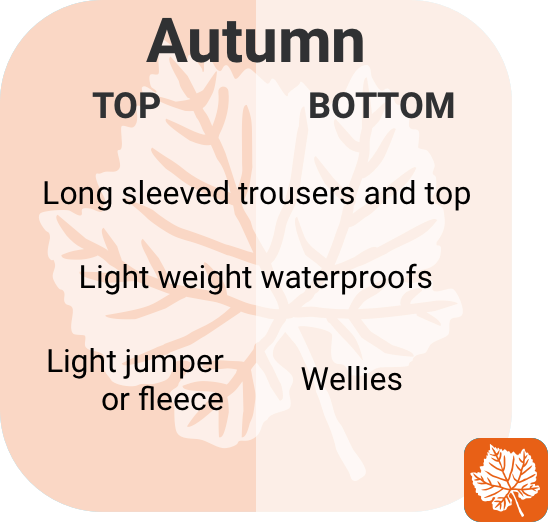


Children will also need to have a complete change of spare clothes, including footwear, socks and underwear. We will take our supply of extra clothes to the woods for emergencies, and children’s spare clothes will be left at the base to change into on their return (if necessary).
Please note that we strongly advise that children wear long trousers, a long-sleeved top and closed-toe shoes whatever the weather.
Please send children in old, well-worn clothes that you don’t mind getting dirty and in wellies or waterproof boots, with a pair of trainers or walking boots/shoes in their bag to change into if their outdoor ones get wet. We request that children bring their spare clothes, water bottle, and packed lunch in a child-sized, (ideally) waterproof backpack, ready to go straight out for the day.
The children will be wearing these, so keep this in mind when purchasing bags. Backpacks with straps across the chest are ideal for preventing the bag from falling off their shoulders.
Please avoid sending your child in shorts, skirts or sandals.
(this is due to the risk of tick bites)

Recommendations
Mittens

Warm Wellies

Waterproofs

Backpack
(or Lidl/Aldi Alternative)

Dry Bag
A healthy packed Lunch

Children are required to bring a healthy packed lunch in their day sack. We have a healthy eating policy which details our expectations for a healthy packed lunch.
Please see the table in the policy document in regards to portions of the major food group.
You will find further nutritional guidance for packed lunches in this useful document
and information about choking hazards here.
AS A DEFAULT WE ARE A NO NUT SETTING. IF THERE ARE NO NUT ALLERGIES WITHIN THE SETTING, WE WILL LET YOU KNOW.
Daysack/Rucksack
We request that children bring their spare clothes, water bottle, and packed lunch in a child-sized, (ideally) waterproof backpack, ready to go straight out for the day.
The children will be wearing these, so keep this in mind when purchasing bags. Backpacks with straps across the chest are ideal for preventing the bag from falling off children’s shoulders.

We have our own unique curriculum based around our rhythms and routines of the day, the seasons, our locality, nature connection, food exploration, cultural festivals, local trips and, most importantly, the children’s needs and emerging interests.
Our curriculum is rooted in the natural world and the natural unfolding of children’s curiosity and fascination in the world.
We are inspired by various approaches to early years education. To find out more about our approach to early years education and the benefits of outdoor learning and development please follow the links: http://outtherekindergartens.co.uk/our-vision- and-ethos
We have also found this useful guide about outdoor play and exploration which clearly sets out many of the things we aspire to at Out There Kindergarten. Interestingly, the guide has been produced by the Froebel Trust, who are strong supporters of Friedrich Froebel, who invented the term Kindergarten which translates as 'children of the garden'.
As an Oftsed registered provision, we must also meet the legal requirements of the Early Years Statutory Framework and, in relation to learning and development in the early years, the 7 areas of learning as defined by the Department of Education. These are;
personal, social and emotional development.
communication and language.
physical development.
literacy.
mathematics.
understanding the world.
expressive arts and design
Through ongoing formative assessment, we observe, assess and plan for each child’s individual learning and development in these key areas. There is a strong focus on the 3 prime areas and we have a very holistic approach to how children learn and develop in these areas.
As a guide, we use the Birth to 5 matters document which is rooted in the 3 principles of the early years stage; a unique child, positive relationships and an enabling environment. This document is written by professionals in the early years sector for people working in the early years sector. Further information for parents can be found here
For more information about learning and development in the early years, you might also want to look at the following documents;
Forest School
Forest School is an innovative educational approach to outdoor play and learning originally developed in Denmark for pre-school children. Children attending Forest Schools were arriving at school with strong social skills, the ability to work in groups effectively, and generally, children had high self-esteem and confidence in their own capabilities. All these attributes proved to be an effective foundation that raised academic achievements. This ethos was introduced to the UK during the 1990s and has been taken on as an effective educational tool in a variety of settings.
Forest school is outdoor, nature-based learning that focuses on the holistic development of the child. In forest school, activities are provided, but rather than being adult-led, each child chooses and tailors the activity to suit them, while we observe their preferences and development. We flow with the energy of the day and follow what children want to do. Forest school is child-centered with a higher adult-to-child ratio. Observation, rather than direction, is key, and children learn to care for the natural environment through their activities.
Forest school helps children develop many skills that are hard to teach in the classroom. It’s very physical so it encourages children to be active, with lots of activities to develop both fine and gross motor skills. Children learn to assess, appreciate and take risks, making sensible, informed decisions about how to tackle the activities and experiences they encounter. They learn to be self-sufficient and take care of themselves, which boosts their confidence and self-esteem. Through trial and error, they learn to deal with failure and develop the resilience to keep trying: a vital skill in the classroom as well as outside.
Forest school ties in with many areas of the National Curriculum. For example, being outdoors year-round helps children learn about weather and the seasons, which are part of the program of study in geography, studying mini-beasts and plant life relates to the science curriculum, and working on tasks like den building and woodwork links with design and technology. Children also benefit from the simple act of being outdoors. Research has shown that it improves mental health, communication skills and social relationships, among other things.
https://forestschoolassociation.org/history-of-forest-school/

There is no such thing as a typical day, as every day is unique and special. We are also governed by the seasons, and the weather, meaning our winter and summer routines are different as a lovely, dry, sunny day is different to a very windy day.
However, we do have certain routines and structure that will benefit your child and prepare them for the next stage of their young life’s journey. Rather than narrowly focusing in on being 'school ready', we like to widely focus out and consider how the rhythms and routines of the day, mixed with our eductaional philosophy, help young children prepare for being 'life ready’.
The day is packed full of nature based play and practical, hands on learning and exploring. At lunchtime, children enjoy a packed lunch (provided by you) and reflect on their morning experiences. We finish our day off with some quite time back at the scout hut, where children can relax and unwind with stories, music, yoga and mindfulness.


Before starting with us, your child will be allocated a key person. You will be notified before your child starts with us as to who your child’s key person is. A key person is someone that takes on the role of a main carer in the absence of the parent. They help the child to settle in to the new environment by forming a close attachment and get to know the child’s individual needs so they know how to support them best. They provide comfort and support if the child is distressed and upset.
Aside from helping to meet your child’s emotional needs, the key person is someone who meets your child’s physical needs too. They will usually help them with such things as getting changed and toileting. Because of the close relationship they build, a key person is also a main point of contact for you, as they give feedback on your child’s day and talk about their learning.


‘ALL ABOUT ME’ MEETINGS - PARENT AND CHILD VISIT
These take place before your child starts with us, and we ask that your child attends with you. This is very important to us and will help us assess whether your child would benefit from a home visit.
We will ensure there are some toys out, and they may get the chance to go out in the garden with one of the team. We will ensure there are some toys out, and they may get the chance to go out in the garden with one of the team.
For children starting in September 2026 this is planned for Thursday 3rd September.
Before the meeting, you will be asked to complete an all-about-me form. This form is passed on to your child's key person. The more information you can include, the better. This helps us to get to know your child, you and your family better.
As part of our settling-in policy, we ask new starter parents to bring a settling-in pack to the all-about-me meeting. This pack might contain a family photo or photos, a special you and a favourite storybook. Please have it in a clear bag with your child's name.
COMMUNICATION IN AN EMERGENCY
To contact us in an emergency, please use the phone numbers provided here
Ella Ives (manager): 07847 709448 - please note Ella works from home on Mondays so you will need to phone Lisa or Alex's number
Miri McGuiness (deputy manager): 07521 465710
Ulrike Haller (third person in charge): 07512 569320
NON URGENT COMMUNICATION
For non-urgent communication, the managers and key people prefer to use Famly newsfeed and Famly messaging.
https://help.famly.co/en/articles/4912443-parents-send-a-private-message
‘The office’ team communicate by email but occasionally puts posts out on the Famly newsfeed if it concerns everyone.
THE FAMLY APP
The registered person will already have been sent a ‘sign up’ request from Famly (requested by Out There Kindergarten) before starting with us. It's important that you have filled out the 'about' section, added emergency contacts and checked permissions. You will be notified and required to read and check if there is any new permission.
We use Famly to share photos, activities, observations and assessments of your child’s learning and development. By registering with Famly, this information will be readily available to you. At the end of your child’s time with us, we will have woven their learning and development journey. It's a great record of their time with us, and you can look back at all the lovely photos with your child to talk about their time with us.
To find out more about Famly, please ask a team member, or you can go to their website, which has a section for parent users of Famly.
The parent who first registered with us will have control of the Famly account. You can add a partner and other family members to allow them access to your child’s profile. The article below helps with this.
https://help.famly.co/en/articles/4912365-parents-add-or-remove-your-child-s-contacts
If you are not receiving Famly communication, please email admin@outtherekindergartens.co.uk.
NEWSFEED ON FAMLY
We share lots of important information on Famly.
weekly updates on what the children have been up to
information about family events
information from the children’s centre and about school places
Please ensure you keep FAMLY notifications on so you don’t miss anything.
HOME LEARNING
We share ideas for home learning via Famly news posts, focus activity posts from your child’s key person and through your child’s observations. If you would like to discuss ideas for home learning, please speak with your child’s key person.
CELEBRATION FAMILY AFTERNOONS
Family afternoons take place towards the end of the day, and usually at the end of a term on a Thursday . They are an opportunity to come and socialise with other families and spend time with your child in the garden. We often share food, music and stories and celebrate some of the children’s achievements with you.
PARENTAL INVOLVEMENT
We love getting parents involved in what we do. We'd love to invite you in if you have something fun and interesting to share with the children. In the past, we’ve had a beekeeper show off his bees and honey, an acrobat who performed the circus and a break dancer who taught breakdancing to young children.
OPEN DOOR POLICY
We also operate an open-door policy with parents, which means you can talk to a member of staff without making an appointment. The time to do this is at the end of the day when collecting your child. Please arrive close to 15:00 if you wish to speak with the child’s key person.

SAFEGUARDING AND CHILD PROTECTION AT OUT THERE KINDERGARTEN
Please make sure you familiarise yourself with the settings Child Protection Policy.
We consider this to be our most important policy.
Our reporting and recording policy supports our child protection policy. You can read this here. At Kindergarten we keep a record of accidents, pre existing injuries, incidents and safeguarding concerns. There may be times when you receive one of these forms from us. This will be either sent through FAMLY or electronically via email. Depending on the nature of the incident or concern, you will receive a phone call from your child’s key person or the senior member of the team to discuss this with you in person before any forms are sent out. If you would like to see an example form, you can access the links to the forms in the policy.
We want to develop a safeguarding community in which we all contribute to keeping children safe. We aim to promote an ‘open culture’ whereby parents and carers feel confident in stating any concerns, either formally or informally about children who attend our setting and even those who don’t. We have a responsibility to safeguarding all children.
The designated safeguarding person for the Brislington Kindergarten is Ella Ives .
The deputy designated safeguarding lead is Miri McGuiness.
Please keep an eye out for any information they might share with your in regards to Safeguarding issues such as online safety. Please also make sure you are familiar with the sickness reporting procedure, which you can find on our website's Policies and Procedure page.
We have a range of other policies in line with the Early Years Statutory Framework. These support our everyday practice and ensure we are all working to safeguard the children in our care. To read our policies and procedures online, please follow or type in your browser this link: https://outtherekindergartens.co.uk/policies-and-procedures.
If you have any questions about our policies and procedures, please speak to the Kindergarten manager.
Permissions, Information sharing and Terms and Conditions
Please make sure you have ticked all of the ‘permissions’ on Famly, either yes or no. We must have your consent for such things as; going off-site to local woods/parks, taking part in forest school activities and administrating first aid. Where we do not have your consent, we will ensure this information is shared within the team and act accordingly.
This also applies to information sharing. There may be times when we need to share information with other professional agencies. For example, transferring your child’s records to school or leasing with the child’s other childcare setting.
We would love your permission to take photos and videos which we can share on social media and other platforms. This really helps us to showcase your amazing children at play in the woods, our fantastic work and with promoting oursleves to potential families and employees. There is a permission for this to check or not check.
We are adding in a new permission this year which relates to the blurring out of children’s faces on photos so that if you do not want to show your child’s face but are okay for them to be blurred out, this can be arranged.
Our Terms and Conditions for Funded and Non Funded Hours are also in the permissions section on Famly with a link to the relevant policy. This is an important policy as it lays out our fees, including the sustainability fee for those using the funded hours.

Our top priority is ensuring that children are safe at all times, whether that is playing in the garden, the public woods or on local trips. We have very thorough risk assessments and policies that ensure children’s safety.
Our top priority is ensuring the children are safe at all times, whether that is playing in the garden, the public woods or walking on the pavements by a busy road. We have very thorough risk assessments and policies that ensure children’s safety.
We have 28 children on the register each day. However, due to sickness and absence the numbers are often lower than this and fall between 23 - 26.
We have 6 core team members (1 manager, 4 key people and 1 early years support person) which means we have higher adult: child ratios than many traditional nursery or preschool settings to account for going off site. If every team member is in attendance our ratios are 1:5. We also often have additional adults such as our early years support workers, volunteers, students and 1:1 support meaning that there is an even higher adults to child ratio.
Children must always be within sight of the adult, and vice versa, meaning they are supervised at all times. The key person and their key children also wear the same colour high viz whilst out, to support head counts, which happen frequently.
The walk to and from Nightingale Valley is along a footpath, away from main roads. When walking to the park or on trips, we use a ‘walking bus’ system, with children in pairs, holding hands and adults strategically placed in the line. We have a ‘safety’ discussion at the start of each walk.
Although we use are public land, we see very few members of the public there during the day, apart from the odd dog walker, as it is off the main path. However, we use orange cones to mark our boundaries and children know they are not to go outside the cones. This is all covered in our ‘Forest Code’ which we go through at the start of every ‘Forest School’ session.


Toileting
Children will be encouraged to use the toilets before we head out. When we are at one of our outdoor sites, we set up a toilet area (with a travel potty and windbreak). This is optional but offers more privacy and can be a comfort to children who are not used to ‘wild weeing’. All Children must ask an adult before they go to the toilet to ensure their privacy. We will support children with toileting as much as they need and work towards independence.
Although we would ideally like children be out of nappies we cannot expect children to be fully toilet trained. We must also be prepared for toilet regression, as going to the toilet in our outdoor setting will be a new and potentially challenging experience for some children. We will equip ourselves for this, as we would do with any aged child when leading Forest School sessions. We have plenty of experience dealing with toileting in our outdoor setting and going prepared with a ‘toilet bag’, which includes spare underwear.
Naps
We often get asked about whether children can continue to nap once they start Kindergarten. As we are a child led setting, if a child requests to nap or is showing signs of falling asleep, we can support naps for individual children. However, we usually find that once the child starts with us they drop their afternoon nap due to being too engrossed in the day and their play. Naps can be, and have been, supported in the garden, indoors and even whilst out in the woods. The child’s key person will ensure the child is comfortable and kept safe and warm.
Please speak to your child’s key person at the all about me meeting if you would like to discuss this further.

We provide longer hours Monday to Thursday in the form of an after kindie club. We provide a light afternoon tea and engage the children in indoor or outdoor play. The session runs from 15:30 –17:30 at the cost of £18.00 per session and must be pre-booked as part of your ongoing weekly Booking Plan.You can allocate government-funded hours towards the cost of After Kindie via the EYR1 Form.
If you wish to book on to the after kindie club mid way through the year, please email admin@outtherekindergartens.co.uk.
Please note spaces are limited to 18 children a day and if there are no spaces available at the time of writing, you will be added to a waiting list.
Please note the following:
We are a pack up/pack down ‘preschool’ and have to leave the place clean and ready for the scout groups which usually start from 18:00. In order for us to do this, we have certain strategies which allow us to be ready on time.
One of these is to pack the resources away from around 17pm onwards. During this time, we rely on the use of screen time ( a suitable, age appropriate t.v programme usually from cbeebies). The children are often very tired at this point and this helps keep them calm and relaxed. Please speak to your child’s key person at the all about me meeting if you would like to discuss this further.
On Thursdays, we operate our weekly team meeting. This will take place in the kitchen or in the main room behind room dividers.
Please collect promptly. Ideally, parents will collect no later than 17.15 allowing time to collect belongings and speak to the adults if needed.
We welcome children from 2.5 years old and have specialist '2 year old leaders' who work more closely with, and support the needs of, the 2/3 year olds as well as advising other members of the team and how we can best support two year old children. We look at the routines of the day, our resources and our curriculum to see how these can be adapted to meet their needs.
In regards to our routines and resources, we would expect younger children to sometimes (not always) take a little longer to settle in and get used to our forest code. During the first few months of starting (in September) and at times throughout the year, we may split the group into two groups, younger and older. This allows younger children (2-3) to do shorter walks, at their own place and for activities to be. It also allows older children (3-4) to engage in more challenging 'forest school' outings and activities.
In regards to naps, we will make provision for naps if requested by yourself or your child or if a child falls asleep in our care due to tiredness. We will have a dedicated calm quiet area and a staff member checking on children regularly. In the past we have done this using pop up tents, making cosy areas, using cushions and blankets. We will record nap times using Famly. Please speak to your child's key person about nap times if it's something you would like us to support.
In regards to children attending in nappies, this is something we facilitate and we have an accompanying policy in relation to this.
Please see our Toileting, Intimate Care and Naps section.

We recommend reviewing the information contained in the links.
Please note that whilst we process EYR1 forms and update booking plans accordingly that you will receive your first invoice in the middle of September and your second monthly invoice at the beginning of October.
Administration Fee
Enhanced Provision Contribution

We have a unique reference number attached to the kindergarten at East Winds.
The number is EY546746. You can find our Ofsted inspection report here.
The registered company is Out There Forest School and Kindergarten LTD and the nominated person is Jenny Brough.
If you have any concerns about our provision, please speak to the manager in the first instance.
If you wish to escalate your concern please contact Jenny Brough on jenny@outtherekindergartens.co.uk
If you wish to make a complaint, please refer to our complaint policy.